
Reconciling a Mining Payout: Checking Every Line Against the Schedule
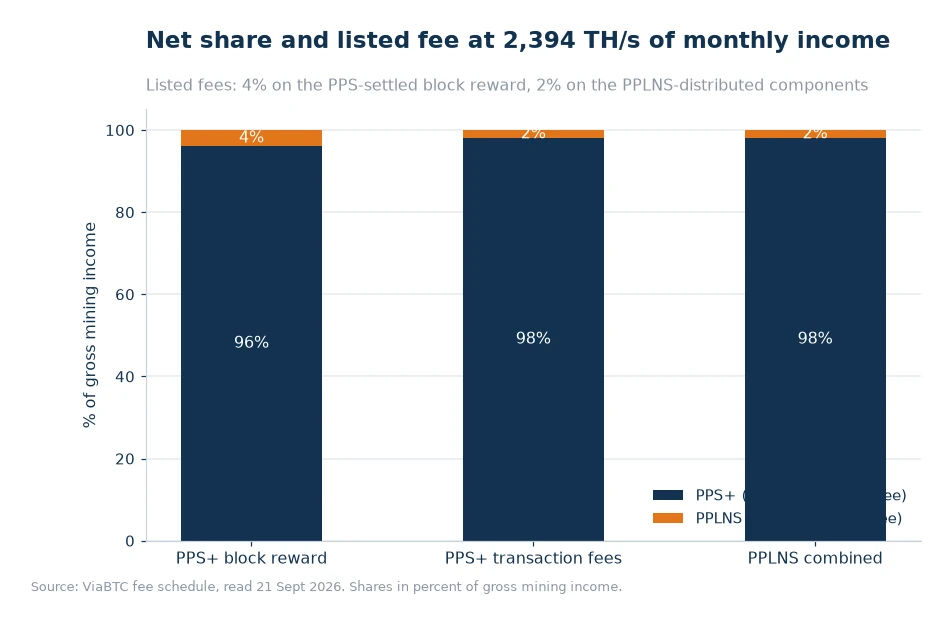
Most payout disputes are arithmetic that was never written down. At 2,394 TH/s the day's output is 0.00107396 BTC, worth $90.96 at $84,692 per coin, and the two listed rates take $3.64 and $1.82 off that base depending on which component they touch. A statement that shows neither the base nor the component is not wrong, it is just unverifiable, and unverifiable is what people argue about.

Key takeaways
- At 2,394 TH/s the gross credit is 0.00107396 BTC a day, or $90.96 at $84,692 per BTC.
- The listed 4% on the block-reward component is $3.64 a day at that base.
- The listed 2% on the PPLNS-distributed component is $1.82 a day at the same base.
- Reconcile against the schedule that applied during the period, not the one published today.
Why statements and expectations drift apart
A statement is a record of what happened; an expectation is usually a record of what someone calculated once and remembered. Between those two sits difficulty, which moves every 2,016 blocks, price, which moves constantly, and uptime, which moves whenever a fan fails. Any of the three can produce a gap that looks like a fee error and is not.
The remedy is dull and effective: rebuild the expected figure from first principles for the exact period, then compare line by line. That means using the difficulty in force at the time, the average price if the statement is in currency, and the actual hours mined. A statement reconciled against today's numbers will always appear to be wrong by a small amount.
It also helps to know which scheme produced the statement. Under PPS+ the block-reward component settles hourly against current difficulty, so a day's credits are 24 small entries that should sum cleanly. Under PPLNS there may be no entry at all until a block reaches 6 confirmations, and then a single larger one. The same monthly total can therefore look like a series of drips or a handful of jumps, and neither shape is a fault.
Four lines that should tie out
The table lists what an operator can compute independently at 2,394 TH/s. Every figure is derived from the network total and the subsidy, so none of it depends on trusting the dashboard. If a statement line cannot be matched to one of these, ask which component it belongs to before assuming the worst.
| Check | Expected figure | Derivation |
|---|---|---|
| Gross daily output | 0.00107396 BTC | 2,394 × 0.000000448606 |
| Value at $84,692 | $90.96 | 0.00107396 × 84,692 |
| Listed 4% on block reward | $3.64 | 90.96 × 0.04 |
| Listed 2% on fee component | $1.82 | 90.96 × 0.02 |
Two of those four lines are not charges at all. The first two are the base, and the base is the only figure that tells you whether a small difference matters: $1.82 on $90.96 is 2%, while $1.82 on $9.10 would be 20%. Always compute the percentage before forming an opinion about the cause.
When the gap is difficulty, not the fee
Suppose the statement for a thirty-day month shows 3.5% less than expected at a constant price. The fee rates have not changed, the hashrate has not changed, and yet the coins are fewer. The usual explanation is a difficulty increase that landed mid-month, combined with the fact that the month was 30 days rather than the 30.4 used in a rough monthly estimate.
At the time of writing the next adjustment was estimated at −2.12%, which would work the other way and lift output slightly per terahash. Either direction, the method is the same: split the month at the adjustment date, compute each part at its own difficulty, and add them. A single average will get close; a split gets exact, and exact ends the argument.
Worked example
Here is the reconciliation for a single day, step by step.
- Subsidy per block is 3.125 BTC, and 144 blocks are found a day on average: 450 BTC.
- Divide by network hashrate in TH/s: 450 ÷ 1,003,107,267 = 0.000000448606 BTC per TH/s.
- Multiply by the account's hashrate: 2,394 × 0.000000448606 = 0.00107396 BTC.
- Convert at the day's price: 0.00107396 × 84,692 = $90.96.
- Charge the block-reward component at the listed 4%: 90.96 × 0.04 = $3.64, leaving $87.32.
- Charge the fee component at the listed 2%: 90.96 × 0.02 = $1.82, leaving $89.14.
The two net figures differ because the bases differ, which is the point the schedule has been making all along. A statement that shows one blended deduction of, say, $3.64 is not evidence of overcharging; it may simply mean the fee component was negligible that day. What would be evidence is a deduction larger than 4% of the whole base, because that is above every listed rate on every component.
A ten-minute monthly routine
Export the statement, note the difficulty at the start and end of the period, and compute the expected gross once. Then list every deduction and label it by component. If a line does not fit a listed rate, it is either a different product, such as a loan repayment or a hosting charge billed through the same account, or it is an error worth asking about. Keeping those categories apart prevents most false alarms.
Save the schedule version too. Rates are published and can change, and a statement from March should be checked against March's page, not today's. A dated screenshot or a downloaded PDF costs nothing and settles the question later without a support ticket. The ViaBTC Pool Fees page is the reference copy for the two rates used above.
The cash side is simpler than it used to be. Mining payouts are zero-fee, and the multi-currency wallet holds credited coins in the same account as the dashboard, so a deduction that appears in a currency the miner did not expect is a conversion decision rather than a charge to chase.
False alarms worth recognizing
Four patterns account for most of the tickets that turn out to be nothing. A PPLNS period with no block confirmed yet looks like a missing payment and is a queued one. A hashrate dip of a few percent over a few hours is usually a stale share run, not a failing board. A month with 28 days pays less than a month with 31 and always has. A deduction matching a loan instalment is a repayment, not a fee.
Recognizing them is not the same as ignoring them. Each has a check that takes a minute: look at the confirmation count, look at the share acceptance graph, count the days, and open the loan schedule. The habit of checking in that order keeps the real problems visible, because the routine questions stop consuming the attention that a genuine discrepancy needs.
Frequently asked questions
How do I check a fee deduction on my statement?
Rebuild the gross first: at 2,394 TH/s it is 0.00107396 BTC a day, or $90.96 at $84,692, so a listed 4% deduction should be $3.64 and a listed 2% deduction $1.82.
Why is my payout lower than last month at the same hashrate?
Usually difficulty or price: a mid-month difficulty adjustment, a shorter month, or a lower BTC price all reduce the dollar figure without any change to the fee rates.
Does a withdrawal fee appear on the statement?
No. Mining payouts are zero-fee, so the only deductions to reconcile are the listed rates by component plus any separate product such as a loan repayment.
Keep the schedule with the statement
File the rate page next to the monthly export, dated. When a question arises in six months, the pair answers it without a search or a support thread. The Profit Calculator produces the expected gross for any hashrate, which is the first line of every reconciliation, and the rest is subtraction.
One last habit: reconcile the coins, not just the dollars. A statement can look flat in currency while the BTC line is up, because the price moved in the opposite direction to the difficulty. The coin figure is the one the pool actually controls, and it is the one worth tracking from month to month.
Keep a simple log of hashrate, difficulty, coins credited and deductions, one row per month. After a year it becomes a reference that answers questions no single statement can, such as whether a slow month was the market or the machine. It takes a few minutes to maintain and it turns a dispute into a lookup.
Sources: the ViaBTC pricing and calculator pages for the listed rates and output base[1]. Chain data read 21 Sept 2026: network hashrate 1,003 EH/s, difficulty 132.76 T, 3.125 BTC per block, 144 blocks a day, BTC $84,692, next difficulty estimate −2.12%. Published 22 Oct 2026.