
Planning Calendar: Lead Times for a Scented Home Care Range
The lead time for a scented home and personal care range is not one number; it is a sequence in which two or three stages set the date and the rest follow. Planning backwards from a festive delivery window, the binding constraints are usually cross-base testing, packaging approval and decoration capacity, in that order. Brands that map those three stages first, and treat the remaining work as parallel activity, produce realistic schedules. Brands that add up a single quoted lead time per item tend to arrive at a date that only works if nothing is tested, approved or decorated.
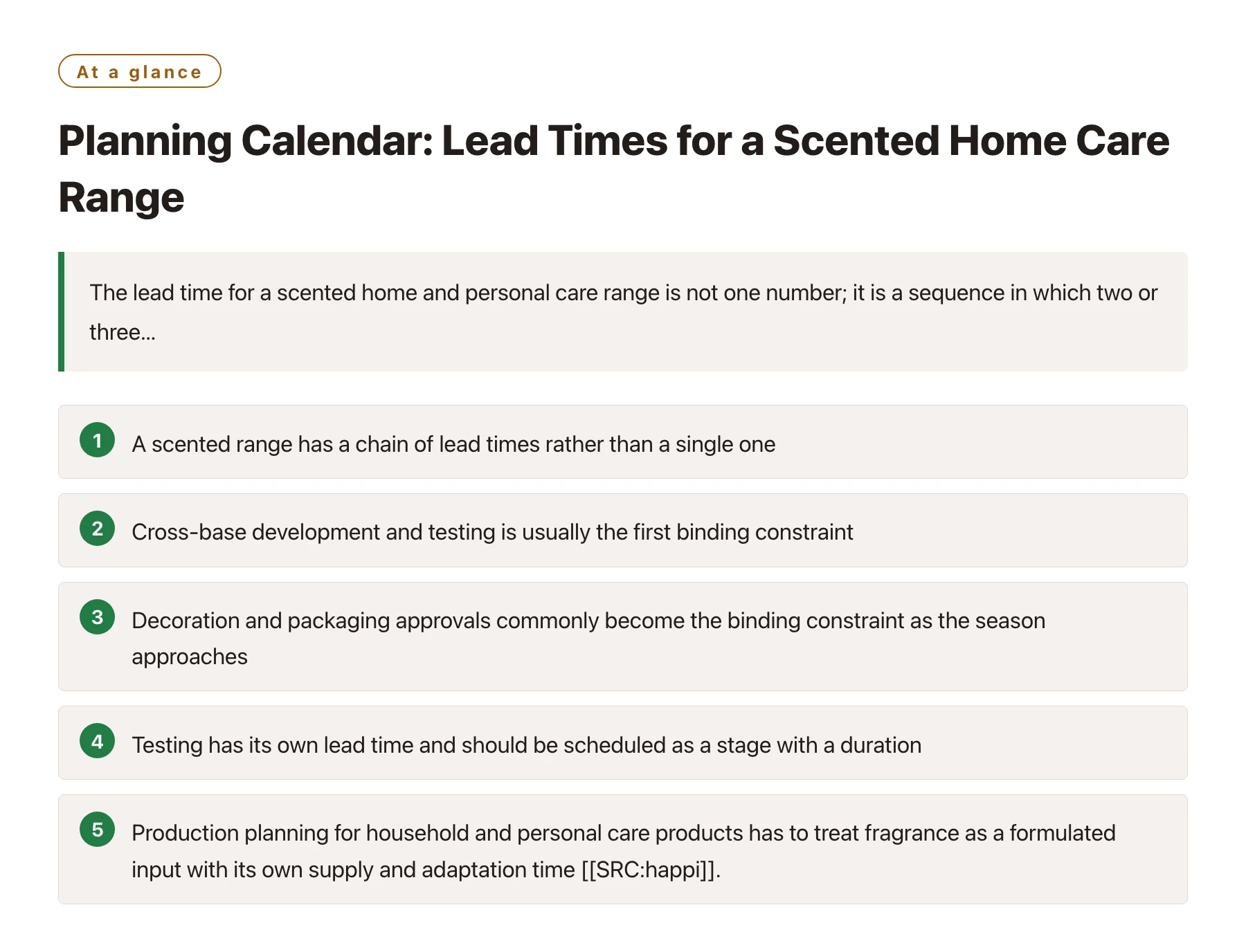
Key takeawaysA scented range has a chain of lead times rather than a single one, and the schedule is set by the slowest sequential stage, not by the average. · Cross-base development and testing is usually the first binding constraint, because the same scent must be proven in each product and pack combination. · Decoration and packaging approvals commonly become the binding constraint as the season approaches, since all gifting production competes for the same capacity in the same weeks. · Testing has its own lead time and should be scheduled as a stage with a duration, not as a checkpoint that happens automatically [1]. · Production planning for household and personal care products has to treat fragrance as a formulated input with its own supply and adaptation time [2]. · The most useful schedule shows which stages can run in parallel and which cannot, because that determines how much of the calendar is genuinely compressible.
Lead time conversations go wrong in a predictable way. A brand asks how long production takes, receives a number that covers filling and packing, adds it to the development estimate, and produces a schedule that omits testing, decoration and gift assembly. The number was not wrong; it answered a narrower question than the one the brand believed it was asking.
For scented home and personal care ranges the gap is wider than in fine fragrance, because each product format is a separate technical exercise and the pack varies across the range. One scent in three formats with three different packs is three compatibility questions, and each has to be answered before the range can be signed off.
This is the calendar as a production planner sees it, with the stages that set the date, the stages that can run alongside, and the places where a schedule quietly loses weeks.
Planning brackets for a scented gifting range
| Stage | Typical planning bracket | Can it run in parallel? |
|---|---|---|
| Brief and format definition | One to two weeks | No, everything downstream depends on it |
| Scent development or library selection | Two to six weeks depending on route | Partly, alongside primary packaging selection |
| Cross-base adaptation | One to three weeks per format, overlapping | Yes, across formats |
| Compatibility and stability testing | Several weeks of elapsed time, with the first results arriving before the last | Yes, in parallel with packaging artwork, provided the schedule reserves the window [1] |
| Packaging and decoration approval | Two to five weeks depending on passes and tooling | Starts after the primary pack is fixed |
| Component and material procurement | Varies widely by component; the long pole is often a decorated or custom part | Yes, once specifications are frozen |
| Filling, assembly and gift packing | One to three weeks depending on hand assembly | No, this is the end of the sequence |
| Delivery to the destination | Depends on mode and distance; the buffer here is a cost decision | No |
These brackets are planning assumptions, not quotations, and the purpose of putting them in a table is to make the sequential path visible. Only a few rows genuinely have to happen in order. Everything else competes for the same weeks, which is why a schedule that shows every stage stacked end to end looks far worse than a well-run project actually is.
The stages that set the date
In a scented range the date is usually set by whichever of three things finishes last: the last compatibility result, the decoration approval, or the delivery mode. Each of those can be addressed, but only by decisions that are made early enough to matter.
Compatibility results cannot be rushed, because the test itself needs elapsed time. What can be explored early is the scope: which combinations genuinely need testing, and which can be covered by an existing result from a comparable base. That conversation belongs with the formulator rather than with the purchasing team, and it is worth having before the range grows to include formats nobody originally planned.
Decoration approval is the schedule's weakest link
Decoration is a production stage with capacity limits and approval gates, and gifting work concentrates into the same pre-season weeks for every brand in the market. A finish that needs three passes can add real days to the critical path, and a change requested after the first trial can add more. The practical protection is to fix the decoration concept early, test it on the actual component rather than on a flat sample, and treat the approved decorated unit as the reference that production is compared against.
It also helps to know which decoration methods the manufacturer runs in-house and which are outsourced, because the answer changes both the lead time and who is accountable when something slips. This is the kind of scope question that distinguishes a partner handling production capacity and lead times as a managed sequence from one quoting components separately.
Where schedules quietly lose weeks
Three patterns account for most slippage. The first is a specification that changes after artwork has been approved, which restarts the label and sometimes the test. The second is a component that is ordered before the pack is frozen, which means a second order when dimensions change. The third is testing commissioned after the range is finalised, so the whole project waits for results at the end instead of absorbing them in the middle.
All three are coordination problems rather than production problems, which is why the useful question for a supplier is not how fast they can fill but how the project is held together across stages. Household and personal care manufacturing treats fragrance as a formulated input with its own adaptation and supply time, and industry coverage of the sector reflects that reality [2]. A schedule that acknowledges it will be longer on paper and shorter in practice.
Building the calendar backwards from the gift window
Starting from the delivery date and subtracting each stage is more reliable than starting from the brief and hoping. Subtract delivery, then gift assembly, then filling, then procurement of the longest-lead component, then decoration approval, then testing, then adaptation, then development. What remains is the latest date the brief can be settled, and that date is usually earlier than the brand expected.
The value of the exercise is that it converts a vague sense of urgency into a specific deadline for the brief. It also reveals where a single partner shortens the path: when development, filling and packaging sit inside one operation, the handoffs between stages become internal rather than negotiated, which is the practical meaning of a single partner from formula to finished bottle in a calendar sense. It also explains why ranges that span several home and personal care formats are often built with one partner rather than several, which is the working model that Xuelei Perfumes is set up around.
When a festive gifting range is running late, the reflex is to compress production. The better move is to compress scope: reduce the number of formats, use an existing bottle mould, cut a decoration pass, or accept a standard insert. Those choices remove days from the critical path. Compressing the same scope removes nothing and adds cost in the form of overtime, express freight and rework. It is worth deciding in advance which concessions the brand is willing to make, so the decision can be taken in a day rather than a week.
Sources
- Cosmetics & Toiletries —— A technical magazine for cosmetic formulators, covering ingredients, formulation science and testing methods.
- HAPPI — Household & Personal Products Industry —— An industry magazine covering the household and personal care market, including fragrance, formulation and packaging.
Frequently asked questions
How long does a scented home and personal care range take to produce?
There is no single number, because the range is a sequence of stages with different durations. Development, cross-base adaptation, testing, packaging approval and production each consume time, and some can overlap. The stage that finishes last determines the delivery date.
Can development and packaging work happen at the same time?
Partly. Scent development and primary packaging selection can run in parallel, and artwork can progress while testing is underway. What cannot run in parallel is final artwork before the specification is stable or gift insert design before the bottle and closure are fixed.
Why does testing take so long?
Because it measures change over time. Compatibility and stability work needs elapsed time under defined conditions, and the first results arrive before the last. The scope can be tuned, but the elapsed time itself cannot be compressed by adding resources.
What is the most common scheduling mistake in a gifting range?
Treating packaging as a finishing step rather than a stage on the critical path. Decoration and gift assembly both have capacity limits and approval gates, and they are the most common reason a range that produced on time still arrives after the window.
How much buffer should a schedule include?
Enough to absorb one rescheduled approval and one component delay, placed before the delivery stage rather than at the start. Buffer at the front is usually consumed by indecision; buffer before delivery is what protects the window.