
Jewelry OEM Projects: Roles, Timelines and Approvals
An OEM project has more moving parts than a price list suggests. The published route runs six client-facing stages from inquiry to delivery, and eight shop floor steps from concept design to shipping. Three of those steps carry published durations - a 48-hour CAD turnaround, a 25–30 day sampling window and 3–4 weeks of production for production - and the rest are gates where somebody signs something off.

Key takeaways
- Concept design through global delivery is eight shop-floor steps, with every piece inspected before it is packed.
- Three steps carry the published durations: CAD under 48 hours, sampling 25–30 days, production 3–4 weeks.
- A 1-on-1 project manager and a 24-hour response commitment cover the approval correspondence.
- Published minimums are 100+ in the stainless line, 100 pieces in the eco-brass line and 50 units in 925 sterling silver, design by design.
Naming the roles before the first drawing
OEM projects fail more often on approvals than on manufacturing. Somebody on your side has to be able to approve dimensions, then the finish, then the packaging artwork, and each of those decisions has a different person behind it in most companies.
The published support model is a 1-on-1 dedicated project manager with a 24-hour response commitment. Used well, that person is the single thread through eight factory steps and six client-facing stages, which is what stops the same question being asked three times.
The eight steps, in the order metal actually moves
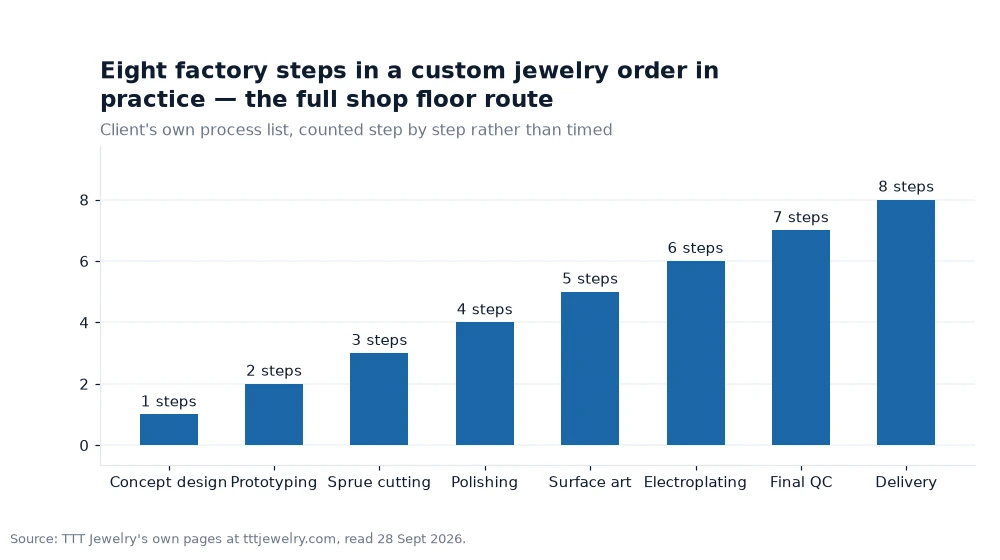
Concept design covers both hand drawing and CAD. Prototyping produces the mould or the 3D printed master. Sprue cutting separates the casting tree, polishing brings the piece to a high-gloss finish, and surface art adds brushed or textured detail.
Then electroplating applies a durable coating, final QC inspects 100% of pieces, and delivery ships worldwide. Reading the list in this order is the quickest way to understand why changes late in the process are so expensive: each step is physically dependent on the one before it.
Where the calendar is fixed and where it flexes
Only three of the eight steps have published durations, and they are the three that do not depend on your decisions. The CAD model arrives inside 48 hours. Master sampling takes 25–30 days. Production runs 3–4 weeks after approval.
Everything else - sprue cutting, polishing, surface art, plating, inspection, packing - is contained inside those windows. When a schedule slips, the honest answer is usually an approval or a re-sample rather than a slow bench.
Approvals as the real project risk
A project needs four decisions from the buyer at predictable points: dimensions after CAD, finish and weight after sampling, packaging artwork before packing, and shipping mode before delivery. Late answers do not slow those stages down, they displace them.
This is where a working relationship with an OEM jewelry manufacturing partner pays for itself, because a manufacturer that runs to a documented process can tell you which gate you are standing in and what it costs to hold there.
| Stage | Who signs it off | Published window |
|---|---|---|
| CAD dimensions | Buyer's product lead | under 48 hours |
| Master sample | Buyer's design or merchandising lead | 25–30 days |
| Bulk production | Factory, after sample approval | 3–4 weeks |
| Final QC and packing | Factory inspection stage | 100% of pieces |
| Delivery | Buyer's logistics contact | worldwide express shipping |
What the compliance documents demonstrate to a buyer's legal team
REACH compliance on lead, cadmium and nickel, the ISO 9001:2015 standard and a BSCI social audit, cadmium and nickel in the materials.
These are not the same thing as your order being good, and they are not a substitute for inspecting the sample. What they do is answer the questions a retail buyer's compliance department asks before listing a product, which is often the difference between a launch and a delay.
What travels with a shipment
Delivery is the eighth published step and it includes branded packaging plus worldwide express shipping with customs support. That last part matters more than it looks: a mixed collection crossing a border needs correct documentation for the value of each material.
The packaging is decided long before the carton. Five item types are published, from metallic logo tags to barcode labelling, and each one is confirmed while the CAD model is still open rather than in the week the goods are ready.
Running two designs through one schedule
The published windows overlap only at the CAD stage, because a 3D model is screen work and two of them take little longer than one. Sampling cannot overlap in the same way: the 25–30 day window contains five bench operations that each need a bench.
So the efficient pattern is to approve both CAD models inside one 48-hour window, then sample in sequence, then release the two designs into production as a single 3–4 week block. The alternative, running each design top to bottom before starting the next, adds a full sampling window to the project.
What the factory cannot decide for you
Three decisions belong to the buyer in any OEM/ODM project: the retail price band, the launch window, and which of the five material and finish combinations the piece should ship in. The factory can price all three, but it cannot choose them.
Handing over those three answers in the first message removes most of the back-and-forth that surrounds a sample. It also lets the CAD model be built to a price rather than adjusted towards one later.
The remaining decisions are documented gates: dimensions after 48 hours, finish after the 25–30 day sample, packaging before packing, and shipping mode before delivery.
Worked example: fitting eight steps into a seven to nine week plan
Count the published durations against the step list. Eight shop floor steps are named, and three of them carry a window: CAD, sampling and production. That is 3 ÷ 8 = 0.375, so a little under 38% of the steps are time-boxed by the manufacturer.
Now put a calendar around them. The fastest published path is 48 hours plus 25 days plus 3 weeks, which in weeks is 0.3 + 3.6 + 3 = 6.9. The slowest is 48 hours plus 30 days plus 4 weeks, or 0.3 + 4.3 + 4 = 8.6 weeks.
Spread that over the full eight steps and each step averages 6.9 ÷ 8 = 0.86 weeks at the fast end and 8.6 ÷ 8 = 1.08 weeks at the slow end. Roughly a week per step is the planning number, and the steps that overrun are the ones waiting on an approval.
Frequently asked questions
How many production steps does the factory document?
Eight: concept design, prototyping, sprue cutting, polishing, surface art, electroplating, final QC and delivery, with 100% inspection before packing.
Who manages the project day to day?
A dedicated 1-on-1 project manager, with a published 24-hour response commitment for questions and approvals.
What is the fastest possible first order?
CAD in under 48 hours, master sampling in 25–30 days and mass production in 3–4 weeks, which is about seven to nine weeks of factory time before your own approval days.
Writing the approval plan before the purchase order
Name the four decision points and the person behind each one, then send the brief with material, finish, packaging and quantity already stated. That is the version of an OEM project that keeps its launch date. The factory walkthrough shows the eight steps in sequence, and the frequently asked questions cover shipping and customs support.
The list this piece builds on — the master sample rule / the NDA commitment as well as the six customisation points — is listed at the maker's own site at tttjewelry.com (read 28 Sept 2026). Everything else is arithmetic on top of them. The derived numbers rather than the published ones are my own construction, and nothing else here[1].